Oscars 2010 Winners: The Hurt Locker is no longer hurting

submit to reddit


List of winners
  • Supporting Actor: Christoph Waltz, Inglourious Basterds
  • Original Screenplay: The Hurt Locker
  • Song: The Weary Kind, Crazy Heart
  • Animated Feature: Up
  • Animated Short: Logorama
  • Documentary Short: Music by Prudence
  • Live Action Short: The New Tenants
  • Make Up: Star Trek
  • Adapted Screenplay: Precious!
  • Supporting Actress: Mo'Nique
  • Art Direction: Avatar
  • Costumes: The Young Victoria
  • Sound Editing: The Hurt Locker
  • Sound Mixing: The Hurt Locker
  • Cinematography: Avatar
  • Score: Up
  • Visual Effects: Avatar
  • Documentary: The Cove
  • Editing: The Hurt Locker
  • Foreign Film: The secret in their eyes
  • Actor: Jeff Bridges
  • Actress: Sandra Bullock
  • Director: Kathryn Bigelow
  • Picture: The Hurt Locker

Hollywood decided that it would honour the little engine that could and ignore box office number. How rebellious! It was about paying your dues, wasn't it? With Jeff Bridges and Sandra Bullock winning their respective category, less for their actual role than for their career and being so darn likable? (Admit it, you teared up during Bullock's speech too!) I'm just pleasantly surprised that Up In The Air went home empty handed, like it should. My favoured horse, The White Ribbon, is not the kind of picture the Academy would usually go for, so it's not a big surprise that it lost out. Still, I was a bit disappointed because the film could've used some free advertisement.

Read More...

Oscars 2010 Predictions: painting Hollywood blue?

submit to reddit


May this be the last time they're trying the 10 best pic nominations experiment. If TV-movie-of-the-week The Blind Side can be included as one of the year's best pictures, you know it's gone to the crap shooter. Not to diss TV production or anything (LOST for the win!), best picture should be a short-list field, not an all inclusive one. It's a race, gosh darn it, not a feel-good circle jerk! Well, okay, not just a feel-good circle jerk. It's not all that honourable if every movie not completely hated by the critics is considered 'best of the year.' Can we have some standards here, people?

Anyway, predictions galore! (Mine / Special guest, Griz's)

Best Picture
Avatar / The Hurt Locker
Alternates: The Hurt Locker / Avatar

Best Actor:
Jeff Bridges, Crazy Heart / Jeff Bridges, Crazy Heart
Alternate: George Clooney, Up in the Air / Jeremy Renner, The Hurt Locker

Best Actress
Sandra Bullock, The Blind Side / Sandra Bullock, The Blind Side
Alternate: Helen Mirren, The Last Station / Meryl Streep, Julie and Julia

Supporting Actor:
Christoph Waltz, Inglourious Basterds / Christoph Waltz, Inglourious Basterds
Alternate: Christopher Plummer, The Last Station / Woody Harrelson, The Messenger

Supporting Actress:
Mo’Nique, Precious / Mo'Nique, Precious
Alternate: Maggie Gyllenhaal, Crazy Heart / Anna Kendrick, Up in the Air

Best Director:
Kathryn Bigelow, The Hurt Locker / Kathryn Bigelow, The Hurt Locker
Alternate: James Cameron, Avatar / James Cameron, Avatar

Original Screenplay:
Quentin Tarantino, Inglourious Basterds / Mark Boal, The Hurt Locker
Alternate: Mark Boal, The Hurt Locker / Quentin Tarantino, Inglourious Basterds

Adapted Screenplay:
Jason Reitman & Sheldon Turner, Up in the Air / Jason Reitman & Sheldon Turner, Up in the Air
Alternate: Geoffrey Fletcher, Precious / Geoffrey Fletcher, Precious

Editing:
The Hurt Locker / The Hurt Locker
Alternate: Inglourious Basterds / Avatar

Cinematography:
Avatar / The Hurt Locker
Alternate: The White Ribbon / Avatar

Art Direction:
Avatar / Avatar
Alternate: Imaginarium / Sherlock Holmes

Costumes:
The Young Victoria / The Young Victoria
Alternate: Coco Avant Chanel / Nine

Sound:
The Hurt Locker / Avatar
Alternate: Avatar / The Hurt Locker

Sound Editing:
The Hurt Locker / Avatar
Alternate: Avatar / Star Trek

Score:
Up / Up
Alternate: Fantastic Mr. Fox / Avatar

Foreign Language Film:
A Prophet / The Secret in their Eyes
Alternate: The White Ribbon / A prophet

Doc Feature:
The Cove / The Cove
Alternate: Food, Inc. / Which way home

Animated Feature:
Up / Up
Alternate: The Fantastic Mr. Fox / The Fantastic Mr. Fox

Visual Effects:
Avatar / Avatar
Alternate: District 9 / District 9

Makeup:
Star Trek / Star Trek
Alternate: The Young Victoria / The Young Victoria

Best Song:
The Weary Kind, Crazy Heart / The Weary Kind, Crazy Heart
Alternate: Take it all, Nine / Almost There, The Princess and the Frog


Although every precursor award points to The Hurt Locker, it seems too small against the record-breaking Avatar to win best picture. If either Avatar or The Hurt Locker wins best picture tomorrow, and the rest of the field looks like what I predicted here, it'd be an empty sort of best picture win - a best picture that either looks good or sounds good, but without award-winning substance (comparable to other pictures). At least, that's what the Academy is telling us with their awards should things go as predicted. And that is, if you care. Which, you really do.

Read More...

Horror in the mirror

submit to reddit


What is it about mirrors that makes them so effective at scaring the bejeesus out of us? Visually, it is jarring: the camera angle is usually such that an unexpected figure in the mirror distorts our sense of reality, for we only see one person in front of the camera. In effect, for a brief moment, the monster is us, the audience, as well as the character, by our adoption of her point of view. In the context of horror films, surprises are often of the unpleasant kind. We are conditioned to fear the unexpected (part of the great unknown), so that even if the monster wears a human face, for a brief moment, we experience that jolt of fear. While mirrors may be used cinematically to express a character's fear from within - and thereby ours - they are effective emotional device that banks on our fight or flight instinct triggered by the confrontation of an unexpected physical event as well.

Furthermore, mirrors themselves are quite strange - the ability to recognize one's self in the mirror has been linked to consciousness / self awareness. You, as human beings, understand that the reflection in the mirror is actually yours and are not terribly confused by the lack of an actual person in the mirror. While some people may claim consciousness to be the sole province of humans, researchers have set out to test for presence of self awareness in other animals. Elephants, for example, have been found to be able to indicate that they recognize when their 'face' is painted (Plotnik, de Waal, & Reiss, 2006). Luckily for them, there isn't any elephant horror film to speak of. The fact that we are self aware and thereby understand what to expect of mirrors is exploited in horror films, as filmmakers subvert our expectations of normal mirror behaviour, much to our delight (or horror?). So the next time you jump out of your seat when that mirrored medicine cabinet is closed and a monster reflection appears on it, don't be ashamed of your manipulated state of fear. You're only human.

Read More...

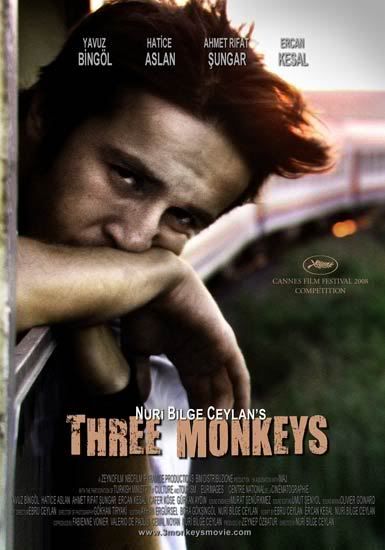
Three Monkeys: the elephant in the room

submit to reddit

Title: Üç maymun (Three Monkeys)
Director: Nuri Bilge Ceylan
Language: Turkish
Year: 2008
Critical Reception: Screened at Vancouver Film Festival 2008, metacritic rating of 73%, Winner of Cannes 2008 for Best Director
Psych Index: Intimate
In Brief: The film unfolded at a steady pace by the assured hand of the Turkish photographer cum director Nuri Bilge Ceylan, who directed the wonderful, equally austere Cannes’ Grand Jury Prize winner Uzak (Distant, 2002). Three Monkeys won him yet another Cannes prize earlier this year, this time as a director, making him one of the international directors to watch. His background as a photographer showed in the composition of the shots and the mood captured in each frame. With Monkeys, he’d strung together a series of moving pictures, hazily beautiful, at once intimate and detached, like memories-filled traveling postcards.

Comment (SPOILERS ALERT):
The title refers to the Japanese proverbial three wise monkeys that are the pictorial maxim for “see no evil, hear no evil, speak no evil.” While there exist multiple interpretations of the maxim, the one that seemed most close to the film was something of an elephant in the room. Without giving too much of the plot away, until the very end of the film, it would be hard pressed to really know what monkeys the film was referring to: the cover-up, the affair, the murder, or the missing piece to the family puzzle. May be all of them.

For a plot that was full of deceit, intrigue and passion, Three Monkeys was stripped down to the minimum, leaving only the slow decay of a family to fully occupy the screen. The events served as only as anchors for the film, for the real action that propelled the film forward was invisible on the page. Though it became apparent half way through the film’s emotional catalyst may have started before the first screen appeared, the film’s story technically began on a dark, winding road where a politician hit the first serious snag of the election, literally. Fearful that a hit-and-run would ruin his political career, he hired his driver to be the sacrificial lamb in exchange for a handsome sum at the end of jail time. While the driver served his sentence, leaving his wife and teenage son to manage for themselves with his monthly salary, the wife and the politician got involved in a discrete little tryst. It was not too discrete, for the son discovered his mother’s little secret, much to his dismay. When the father finally came back, there was little to do to contain the emotions boiling over. One mistake lead to another, and the price to be paid for silence became the hot potato that got passed on to the nearest frog in a hole.

The film unfolded at a steady pace by the assured hand of the Turkish photographer cum director Nuri Bilge Ceylan, who directed the wonderful, equally austere Cannes’ Grand Jury Prize winner Uzak (Distant, 2002). Three Monkeys won him yet another Cannes prize earlier this year, this time as a director, making him one of the international directors to watch. His background as a photographer showed in the composition of the shots and the mood captured in each frame. With Monkeys, he’d strung together a series of moving pictures, hazily beautiful, at once intimate and detached, like memories-filled travelling postcards.

The estranged characters functioned as loners in spite of their clumsy attempt to reach out for each other. Twice, the image of a single alley cat prancing across the screen contrasted with the character’s shape sharing the same frame. The cry of a cat can be awfully lonely and haunting, and its presence in the film – along with the surprisingly creepy and sad missing-piece-of-the-family-puzzle – gave Monkeys a spiritual dimension befitting of the best psychological horror films. The cast felt like real people, breathing and aching like real people, packing an emotional punch to each of their performances, even if their circumstances felt a bit unreal.

There could be some comparisons drawn between the film and Robert Redford’s Ordinary People. Both films dealt with family guilt, grief, and disintegration, though they could not be more different in style of expression. Whereas Ordinary People had an earthy, warm colour to the picture, Three Monkeys‘ brown was more green in shades. The latter also was decidedly less chatty about reasons and feelings, in keeping with the oblivion alluded to by the film’s title. If you’d prefer to do the analysis yourself rather than leaving it up to a film to spell it out, Three Monkeys would probably fit your sensibilities better. Even if you’d left the film puzzled by some loose ends, at the very least it would’ve been a strangely hypnotic, if not pretty, journey.

Clip:

Read More...

Inside the Oscar campaign

submit to reddit


NY Mag has an encompassing article on the Oscar campaign.

The Messenger, which has grossed only about $800,000, is probably the least-seen movie that has a shot at a Best Picture nomination; after the AFI ceremony, in the driveway of the Four Seasons Hotel, I hear a publicist for a rival film mutter grimly into his cell phone, “I don’t know if that movie is on the radar or not, but that clip killed.” The Messenger is distributed by Oscilloscope, a New York–based indie run by Beastie Boy Adam Yauch and David Fenkel. “You never know how these things will shape up,” says Fenkel. “Every couple of weeks, films that you thought were contenders turn out not to be, so you’re constantly revising your expectations. And what we found was that in early December, Woody Harrelson’s performance started getting a lot of traction.”

For movies without a huge campaign budget, that kind of break is critical: Actors form the Academy’s largest branch, and a talked-about performance like Harrelson’s can lead voters to watch the DVD and perhaps consider other long-shot choices—like the screenplay (which does, in fact, get nominated) or even the film itself (which doesn’t). Oscilloscope sent screeners to voters early, a real gamble for a company without even a small studio budget, where even a single “For Your Consideration” ad page, which commands between $13,000 and $30,000, requires a cost-benefit analysis. But even in a season of relative austerity, money still matters, and it’s hard to argue that the playing field is level when you’re driving from one studio party to another through a city in which every other billboard (price: $50,000 and up for four weeks) seems to be touting Inglourious Basterds or Up in the Air. (At least Up in the Air is still trying to sell movie tickets. The billboards for Basterds, long gone from theaters, are clearly meant for Academy voters only—Harvey Weinstein, who released the movie, being Oscar’s most remorseless campaigner.)
Avatar would shatter precedent by becoming the first Best Picture winner since 1933 to take the prize without any acting or writing nominations. The Hurt Locker, which has taken in just under $13 million at the U.S. box office, would shatter precedent by becoming the lowest-grossing winner since the fifties.
Bullock, who has never come anywhere near an Oscar nomination but is riding a wave of big box office and positive press for The Blind Side, is almost as good as Streep at the podium: She gives the kind of emotive, funny, ingratiating speech that makes people say, “Maybe she should win,” just because it seems like fun. All at once, we have a contest—and the most interesting acting face-off of the season, since the excellent narrative behind Streep (namely, There Is No Way on God’s Green Earth That This Woman Should Have Fewer Best Actress Oscars Than Hilary Swank) must now fight off Bullock’s, the much simpler Who’da Thunk It?!
And why James Cameron is basically trying to lose his Oscar:
“I would ask you not to be humble,” the first questioner begins. No problem. Cameron quickly advances what amounts to a three-pronged case for why Avatar should win the Oscar. Ebulliently, he muses that the film’s technological leaps could “give permission to other filmmakers” to take 3-D out of the ghettos of “high-end animation and lowbrow live-action”; he points out that the movie, which he envisioned as a “shameless engine of commerce,” is only the second sci-fi film to take this prize; and he notes that it’s “very interesting that a major Hollywood commercial film is in some way controversial, whether it’s the environmental theme or some of the political themes.” It’s an aggressive sell: Tonight, he wants all of the Oscar narratives—The Chance to Make History, The Popular Favorite, The Movie That Speaks to This Moment.

And then, he goes too far. He keeps talking. And he does the one thing that no winner should ever do in a roomful of journalists: He disses Meryl Streep.

A reporter asks him why Avatar’s motion-capture performances haven’t gotten more respect from actors. “I’m going to give you an example,” Cameron says, clearly recalling the encounter I witnessed with the actress after the Critics’ Choice Awards. “I had always wanted to meet her—and I was talking about the performance-capture stuff and I was mentioning how all the actors love doing it. And she said, ‘Oh, yes, I know. I had such a great time doing Fantastic Mr. Fox.’ I thought ‘Oh, my God, this is a perfect example of what’s wrong!’ She didn’t perform the character physically over a period of months. She did a voice performance maybe for a day, maybe for two days, on a lectern!” From far away, I can feel Fox executives emitting psychic beams: “Stop talking now.”

“It’s almost like Asperger’s with him,” a producer tells me later. “How many years has it taken him to live down ‘I’m the King of the World!’? When he shifts into that mode of talking about how great his movies are and how other people just don’t get it, he is literally incapable of understanding how he sounds. And I say that as a fan! He makes it incredibly hard to vote for him.”

Read More...


Recently Seen (out of *****)

  • One night in Miami (King, 2020) ***
  • Mank (Fincher, 2020) ***1/2
  • Coming 2 America (Brewer, 2021) **1/2
  • Ma Rainey's Black Bottom (Wolfe, 2020) ***1/2
  • I care a lot (Blakeson, 2020) **

Copyright © 2016 Cinema Psychologia All rights reserved.
Converted To Blogger Template by Anshul Theme By- WooThemes