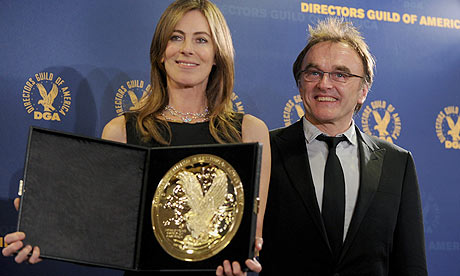
Kathryn Bigelow, first woman to win DGA

submit to reddit

For no less than a well-executed, tight, tense 'action'/war film, which is normally the province of the big guys. Granted, most directors are male so this is kind of a biased fact. Still, Ms. Bigelow deserves the recognition not only because her picture, The Hurt Locker (recent winner of the PGA), benefited the most from her vision, but also because her work was the best of the bunch nominated, Tarantino excluded. And it gives hope for those of us who like to obsessively follow the Oscars that it would not be a completely blue race (read: Avatarized).

Kathryn Bigelow took a major step towards this year's best director Oscar when she scooped the top prize at the Directors Guild of America awards on Saturday. Bigelow became the first woman to win the DGA award in its 62-year history. No woman has ever won the Academy Award for best director. Bigelow won for The Hurt Locker, a tense, ground-level account of a US bomb disposal team on the streets of Baghdad. "We all felt a really deep responsibility to tell this story with as much honesty as possible, given the courage of the men and women in the field," Bigelow said. She took the prize ahead of fellow nominees Quentin Tarantino (Inglourious Basterds), Lee Daniels (Precious), Jason Reitman (Up in the Air) and Golden Globe winner James Cameron (Avatar). (The Guardian)

Read More...

Che (Soderbergh, 2009): Burying an icon

submit to reddit

Title: Che
Director: Steven Soderbergh
Language: Spanish, English
Year: 2009 (Canada), 2008 (U.S.)
Critical Reception: J. Hoberman gave an admiring review.
Psych Index: Social Relations
In Brief: An ambitious, drawn-out film that succeeded in making one feel very discouraged by the guerrilla life.

Comment (SPOILERS ALERT):
Che (Soderbergh, 2009) premiered this weekend in Canada, playing just two screens a day in Vancouver. Considering the notoriety of the subject, it might seem surprising that it wasn't a wider release. When I got to the theatre, however, having read nothing about the film's release format, I was surprised to learn that it was a Special Roadshow Edition being shown. It meant that the film was broken into two parts, screened with a 15 minute intermission. I was game for it - when was the last time you saw a film with an intermission? For a film geek, that's a treat rather than a deterrent. Besides, Soderbergh's treatment of such a controversial figure, one that I knew very little about, was enticing enough for me. It was going to be a special film. Or at the very least, it was going to have to be an ambitiously grand film, and I figured it'd need all the audience it could entice for it to survive.

It was a grand film alright - in temporal sense of the word. Che was a grueling procedural film about the grueling time of a guerrilla icon. Altogether, one needs to invest about 5 hours of one's life committed to experiencing the film. And experiencing it, one must - Soderbergh made sure of that, declaring his intention of making the film "a procedural about guerrilla warfare." This procedural love of his has always threatened to be the most frustrating aspect of Soderbergh's filmaking; it sank his Ocean's Thirteen film (and the series). Here, one has to wonder if there's enough justification for a large chunk of the film. When art attempts to imitate life exactly as it is, the end may not justify the means, and the sum may not be greater than the details leading up to it. I once attended a play about Time. It was a greatly frustrating play, as a big chunk of it was spent on making the audience feel time passing by, with actors doing nothing but arranging rocks and playing with sand randomly and slowly on stage. I got the message and I never wanted to be subjected to the messenger again. Unfortunately, this was how I felt about Che.

There is a place for procedural films in cinema. The most successful one that comes to mind is Luc Bresson's Un condamné à mort s'est échappé ou Le vent souffle où il veut (A man escaped, 1956). A large part of success for A Man Escaped was in the tension and the atmosphere created by the framing of the film. It also helped that there was investment in the outcome of the film, one that was rewarded after an hour and a half of actual film time. Four-hour plus running time of Che was not very conducive to the success of a procedural film. If there was any ounce of excitement or glamour in a guerrilla life, Soderbergh killed it with the second half of Che. Perhaps that was the point - guerrilla warfare is no hike in the park, kids. However, it did not make for particularly rewarding cinema. There was little that was moving forward; most of the second half of the film was spent meandering about in small, repetitive steps. It was almost-dead cinema at times, complete with the choice of drained-out colour to go with the long and tiring day-in-the-life of a guerrilla.

There is also definitely a place in cinema for experiential films, those that attempt to give the audience the actual experience being depicted in the film. In recent years, the Austrian/German auteur, Michael Haneke, has been particularly successful in mirroring the characters' experience with the audience's, blurring the line between spectators and participants (see Caché, his best film to date). It's a worthwhile experiment, and experimenting is one way to ensure growth of an art form. It was a double edge sword for this film, however. On paper, it would seem ingenious to give the world a sense of what it was like living Che's life. It succeeded on this front, if one was to believe the joylessness of his raison d'être. For the most part, one had the feeling that his life was a cold, bloody intellectual pursuit of communal ideals at the cost of reasonable doubts. Certainly there were small moments of human affection, mostly from the first half of the film. Experiential films are most powerful and/or interesting when the experience depicted was itself powerful and/or interesting. When half of the film was spent going nowhere, one may start to look for interesting pockets in between. Look at the trees! Exotic animals! Someone pees a message! Striking images! Something cinematically interesting happens, please! No? Oh, someone felt insulted by being called a ventriloquist! That was probably the most happening scene in thirty minutes leading up to it.

The decision to combine the experiential with the procedural in this case gave us the head scratching experience that was Che. Matter-of-fact depiction of a highly charged figure may have been an interesting approach, but I can't help but feel that it was a counter productive one. Che was a symbol of the people at some point, and this was no film for the people. There was an interesting experimental film here, but it was buried by the need to draw every single line of Che's life (in this period) with no sense of economy. For all the details going into making the film feel authentic, there was little of Che to be abstracted from the film. Perhaps we were not meant to understand what drove him, other than what was stated by the man himself (belief 'in humanity' and the need to deliver justice to the poor people). His success and failure were very clearly contrasted by the two parts of the film. It was interesting watching how his ideals unfolded under different circumstances (which he thought were the same, obviously) with drastically different results. His failure indeed illustrated a lesson to be had, as he predicted, though perhaps not in the way he anticipated. Che did not account for the multitude of factors other than just poor conditions for people to really throw their hats in the ring; you can't simply will a revolution for the people without their consent.

I admire the ambition of the film and the sheer audacity of the film's release format - 4-hour plus historical war epic screened in one sitting with a 15-minute intermission is a lot to ask of the modern blockbuster-fawning, short attention-span audience. Soderbergh wanted to open Che up to the world, turning him into more than just a face on a T-shirt. He succeeded in nailing the coffin of Che's cause, while simultaneously generously praising the man. Perhaps Che was meant to be a labourous war film about a highly charged political figure that remained elusive as a full-fledged man. Without a proper understanding of the man, his motivations and needs, however, he remained a T-shirt symbol to me, whatever that symbol may be.

Clip:

Read More...

Drag me to hell (Raimi, 2009): A modern woman dragged to hell

submit to reddit

Title: Drag me to hell
Director: Sam Raimi
Language: English
Year: 2009
Critical Reception: Metacritic rating of 83, Rating of 100% from Wall Street Journal's Joe Morgenstern, 90% from Salon's Stephanie Zacharek, 80% from the Village Voice's Nick Pinkerton
Psych Index: Gender role
In Brief:Being a modern woman is never quite completely good and moral as often demanded of characters in horror films, and it is rare that a film existing in fantasy would be inspiring with its choice of such a realistic (or at least close to being as such) lead. The filmmakers may have been overly critical of this particular modern woman, but in doing so, they made her one of the most fascinating and complex leads to watch in a genre that’s not particularly known for depth. In turn, she made the film surprisingly more substantial and interesting than all the fun gags could reveal.


Comment (SPOILERS ALERT):
Drag Me To Hell (Raimi, 2009) opened as a counter-programming film to Disney/Pixar’s Up. For a horror film, especially considering the current crop of films in that genre, its PG-13 rating seemed a little suspect. How can a good horror film have anything less than a presumably envelop-pushing R-rating? What of violence and nudity that make up most of the genre? By the time our heroin, Christine Brown (Alison Lohman), engaged in her first battle with the woman who would be placing a curse upon her (Mrs. Ganush, played with ferocity and a sense of fun by Lorna Raver), it was clear that what the film may lack in nudity and gore, it made up for it in humour and over-the-top grossed out goobs.

To be sure, there was not much here in term of plot (as expected in the genre): Christine was a loan officer who, in an attempt to prove her worthiness to her boss, made a decision to shelf away compassion (or was it really guilt?) and deny an old gypsy woman of another chance to live out the rest of her life in comfort and dignity. As an act of vengeance against what she saw as a deliberate attempt to shame her, Mrs. Ganush, after an outrageously funny and suspenseful cat fight with Christine, placed a wretched curse upon her. Christine then met with a psychic, Rham Jas (Dileep Rao) who was not only knowledgeable of the curse but also knew of whom she should ask for help from – at a negotiated price of the cold cash variety. Much haunting ensued within the three days that Chrsitine had left to prevent having her soul dragged to hell by an invisible Lamia. Of course, there was also a twist ending (that we could see miles away, but it was deliciously satisfying, nevertheless), and its conclusion underlined a strong moral statement the film seemed to take a vested interest in.

The Raimi brothers knew how to imbue their picture with a sense of humour while remaining true to the traditions of the genre. This difficult balance – winking while running on adrenaline – played itself out not only with the way the picture was filmed (music, gags, cheesy lines and sound effects were in full force, intermittently interrupted by the still scenes and slow tracking shots) but also in our heroin, Christine. Women are one of horror’s favourite subjects – most of the genre could be argued to have been built on the strength of women’s thighs and other close-by regions. If the central character happened to be of the female variety, she would be expected to have the audience’s sympathy at least by the end of the film. Our horrified heroin is often violated against in some manners, and she would often have the higher moral ground compared to our villain(ess). In Christine, the Raimi brothers threw in their best twist and most biting comment in the film yet.

Christine was very much a picture of a modern woman, a determined social climber who, on sheer will and smarts, had gone from a chubby pork queen of a farm girl to a candidate for an assistant manager at a bank, with a young and devoted professor of psychology as her boyfriend (his name, Clay, suggested a certain boring malleability though – Justin Long was perfectly cast for once). In her first fight with Mrs. Ganush, after locking down her car windows and watching the old woman flail seemingly helplessly against the glass, she yelped victoriously from inside the car: “I BEAT you!” She was eager for self-congratulations throughout the film – she wanted so badly to beat the odds that she would prematurely celebrate any inroads. There was a certain glee in her tenaciousness and willingness to go the necessary distance to survive. No doubt in her mind she was a worthwhile heroin who would overcome and rise above life obstacles. The events that unfolded would show her to not be completely in sync with what she would like to think of herself, however.

In the course of the film, Christine painted herself – in words, mostly - to be a compassionate, grateful woman: she professed to be a vegetarian who loved animals (see how that fared out in the film), she confessed her wrong-doings to her safety net of a boyfriend (to which he replied ‘you’re such a good heart’), she acknowledged her background (Clay’s mother found her admittance to be a sign of a backbone, when it could be interpreted as another instance of her blaming others for her troubles) and she showed hesitation in both times she had to make a difficult moral decision (at first, with Mrs. Ganush, and later, with the handling of the cursed button). However, her good deeds seemed to stem from either guilt (her name, Christine, was a bit of a giveaway) or self-interest (survival), as would be the case for most ordinary human beings.

In the relative calm of an ordinary life, it was easy for her to be a good Christian. After all, it’s easier for most of us to be good citizens when the structure is there to encourage moral acts: presence of a recycling bin would encourage more recycling at a given location, for example. It’s easier to give away millions when you earn trillions. When you have all the time in the world to drive home, allowing someone to bud in a busy traffic line may not be such a big deal. If Christine was not in the position to climb the corporate ladder, she may have given Mrs. Ganush the extension she needed. When the rugs were pulled out from under her, however, Christine looked to use any shield she could find; on more than one occasion, upon being accused of committing an amoral act, she insisted that her boss was the one who started everything (he was, indeed, as part of the system that enabled her action, but the ultimate decision was hers to make). She let others put themselves at risk for her. To her credit, she showed herself to be a woman of some principle – another person may not have hesitated as much as she did with her decisions, and may not have thought twice about the fate of the cursed button. Guilt sometimes can inspire such great moral acts.

As a modern woman, she also showed much self-reliance and resourcefulness. Even when she was cornered, she either did not rely on help from her man (her pawning everything she owned to help herself was touching and surprising), or was left by chance (fate?) to fend for herself (the phone call would not come through). In some ways, sadly, she was all the defense she had, but being alone did not make her a special case. Rham Jas referred to Christine once as an “insignificant” person, and it deflated the sense of self-importance some social climbers have of themselves. In the context of a horror genre, it was unusual to have a protagonist not be specifically ‘chosen’ for a role. When ordinary characters are cast, they would often be given opportunities to do extraordinary things. This would have been an easy way for the audience to feel good about themselves and their fellow beings – who doesn’t want to be inspired? The fact that Christine was not a special case made her special in the larger context, ironically. Unfortunately for Christine, being ordinary did not do her any favours when it came to dealing with the extraordinary. The events in the film seemed to also point to true morality revealing itself only in the heat of fire, and that some of the people who would not live up to this test (that would be most of us) may (or should?) not get away with their slip on the moral compass.

Because of these complexities, Christine inadvertently became more interesting and unusual in the context of the genre: the audience may find themselves feeling ambivalence towards her fate, as she would gain and lose sympathy, sometimes within a few frames (Lohman was superb at embodying these shades of grey). Being a modern woman is never quite completely good and moral as often demanded of characters in horror films, and it is rare that a film existing in fantasy would be inspiring with its choice of such a realistic (or at least close to being as such) lead. The filmmakers may have been overly critical of this particular modern woman, but in doing so, they made her one of the most fascinating and complex leads to watch in a genre that’s not particularly known for depth. In turn, she made the film surprisingly more substantial and interesting than all the fun gags could reveal.
Clip:

Read More...

People: Rodolfo Llinás on movement, mysteries, and nanowires

submit to reddit

Touted as "the founding father of modern brain science," here's a video where Rodolfo Llinás talks about his background and discusses the brain's consciousness, posted on The Science Network. It's a really long video (one hour plus) but it's fascinating, nevertheless. Keep in mind that this is someone who is deeply involved in the scientific community, and one who says that "we are our brains" and that "you can’t love an entity you don’t see or understand," so you know where he's coming from.

One of the points he mentions is that our life is driven by movement, a concept that's been suggested by other older psychological figures (e.g. Alfred Adler), and that the brain is the instrument for motricity (or movement). He defines movement in a more motor-esque manner - that is, stationary plants don't really move, as they just "eat their brains." This is quite interesting, though questionable, since plants do move - very slowly - if you give them time. It's too bad that he's so spatial about it.

He also talks about Sir Charles Sherrington's (a very famous neuroscientist who coined the word synapse) idea that "somehow in order for us to respect each other, in order for us to love each other, in order for us to be kind, to be civil and so on, there had to be a mystery type component to the whole thing. That if we were to really understand why we love and what we hate and why we do what we do, that somehow the drive, somehow that which makes us human would disappear because somehow humanity is fed by the mysterious and by the unknowable."

Of course, being the one who dedicates his life to finding out as much as possible about the brain, he disagrees with the notion that we need mysteries to live with each other. Quote:

the more you learn about the nature of what we are, the more we would like each other and the more we would understand each other. Mostly what we do is not so much hate each other. What we mostly do is not understand each other. So indeed if I, I think if I could really understand another human being as well as physically possible, let’s say, that individual becomes more interesting to me rather than less interesting. At least this happens with everything else that I’ve done in life and probably happens to most people and happens for sure to scientists. That the more they understand something, the more they like it, the more they love it, the more they understand it, and there’s an incredible feeling of, not of possession, but of being a part of something when you understand it.

The fallacy here is, of course, the idea that the more you understand something, the more likely you'd feel affection towards it. Would an understanding of someone like Hitler, or a given psychopath, make you like him/her more? And from academic research, we can bloody be assured that more answers lead to more questions.

Also, ironically, he runs into the natural physical barrier that prevents us from literally see what another person's brain is doing: the cranium that guards the brain and makes it opaque to outsiders. That is, we are mysterious by nature, literally. So what do scientists like him do to get around this? Nanowires. He explains:
the brain is full of holes, don’t make any new ones. And what are the holes I’m thinking about? The vascular system. So imagine. The blood vessels, right. Imagine yourself becoming very small in this beautiful whole film- science fiction, into the vessels and you go into the brain. Where can you go? Anywhere. The brain is completely vascularized. It’s full of these vessels and they occur every 15 microns, it’s a 3-dimensional scaffolding that goes everywhere. And then the question is, don’t go to the brain through the outside, go to the brain through the inside. Why not put a wire up to anywhere you want in the brain and try to record or stimulate or both. But it has to be a very thin wire because you don’t want it to bother circulation. It has to be of such material that it’s not recognized by the body as being there.
At this moment we are getting to about a 30 nanometer wire. It is a third of a micron- a micron being very small- thousandths of a millimeter. You can put several hundred in the diameter of a single hair. Ok so you float this thing, say you want to do more than one, you want to do ten or a hundred or a thousand or ten thousand or however many, so you can wire the brain from the inside. What can you do? Two things, you can record and you can stimulate.
yes you can repair things. Or you can have man-machine
interface. Seriously for the first time, seriously seriously. You need to remember the name of all the people that you know so you have a little bank in principle might be able to whisper to you the names of the people whose names you need to remember. You may buy a good program to learn or play chess. There are many things that you can do once you have direct access to the brain.
Yeah, brace yourself for the future of controversies.

(Transcript provided by Chanel N).

Read More...

Groundhog day and the Jungian shadow

submit to reddit

An interesting take (SPOILERS GALORE) on Groundhog day (Ramis, 1993) following this brief explanation of the Shadow:

Jung often referred to the dark side as "shadow", and he believed that not only individuals, but also whole nations, communities and groups had shadows that had to be encountered. He felt that the shadow has typically been demonized and "made evil," rather than viewed in a philosophical and more fair or equitable light.

The shadow is a "dangerous peculiarity and a valuable and congenial asset as well" and contains not only the undesirable elements of life, but also the "dark springs of instinct and intuition," which mere reasonableness could never call awake.

The Shadow is that part of us we fail to see or know, all that we would not want to be, and it is the sum of all those unpleasant parts of our personality that we prefer to keep well hidden, our baser, more primitive side. It is the inferior, dark, undifferentiated side, in conflict with the conscious Ego. The Shadow represents something inadequate and includes those qualities that clash with the established norms of social behaviour.

Some Jungians have written about the gold in the shadow, believing that what consciousness rejects is often the stuff of life that may give it its highest value. The unconscious introduces new dimensions and might have a very different moral view compared to the one conditioned by society.

Whilst exploring the Shadow, the goal is recognition rather than integration: accepting the negative and welcoming it as a pole of energy is less a true process of integration than a sort of coming to terms with the Shadow (just as the energy previously dispersed in the Shadow becomes exploitable by the Self), since eliminating it entirely appears an almost impossible enterprise. After all, for human beings to be complete they must, of necessity, have some deficiencies.


Bearing this in mind, in my opinion the key shot of the movie is when we see the name of the groundhog (Phil!), carved in wood, appearing right above Phil Connors' head. It is hard to believe this is a mere coincidence, and not to think that it might have sprung from the depths of the director's own concept of the Shadow.

For Phil, living the very same day over and over again will bring about Phil Connor's honouring and accepting ("seeing", as the Groundhog) his own shadow through a profound discipline. Moreover, this process will bring him love with the woman who has been with him all the time, and the "winter" of his heart and his soul is over.

Read More...


Recently Seen (out of *****)

  • One night in Miami (King, 2020) ***
  • Mank (Fincher, 2020) ***1/2
  • Coming 2 America (Brewer, 2021) **1/2
  • Ma Rainey's Black Bottom (Wolfe, 2020) ***1/2
  • I care a lot (Blakeson, 2020) **

Copyright © 2016 Cinema Psychologia All rights reserved.
Converted To Blogger Template by Anshul Theme By- WooThemes